Guide: EV charging
EV charger installation cost in the UK (7kW)
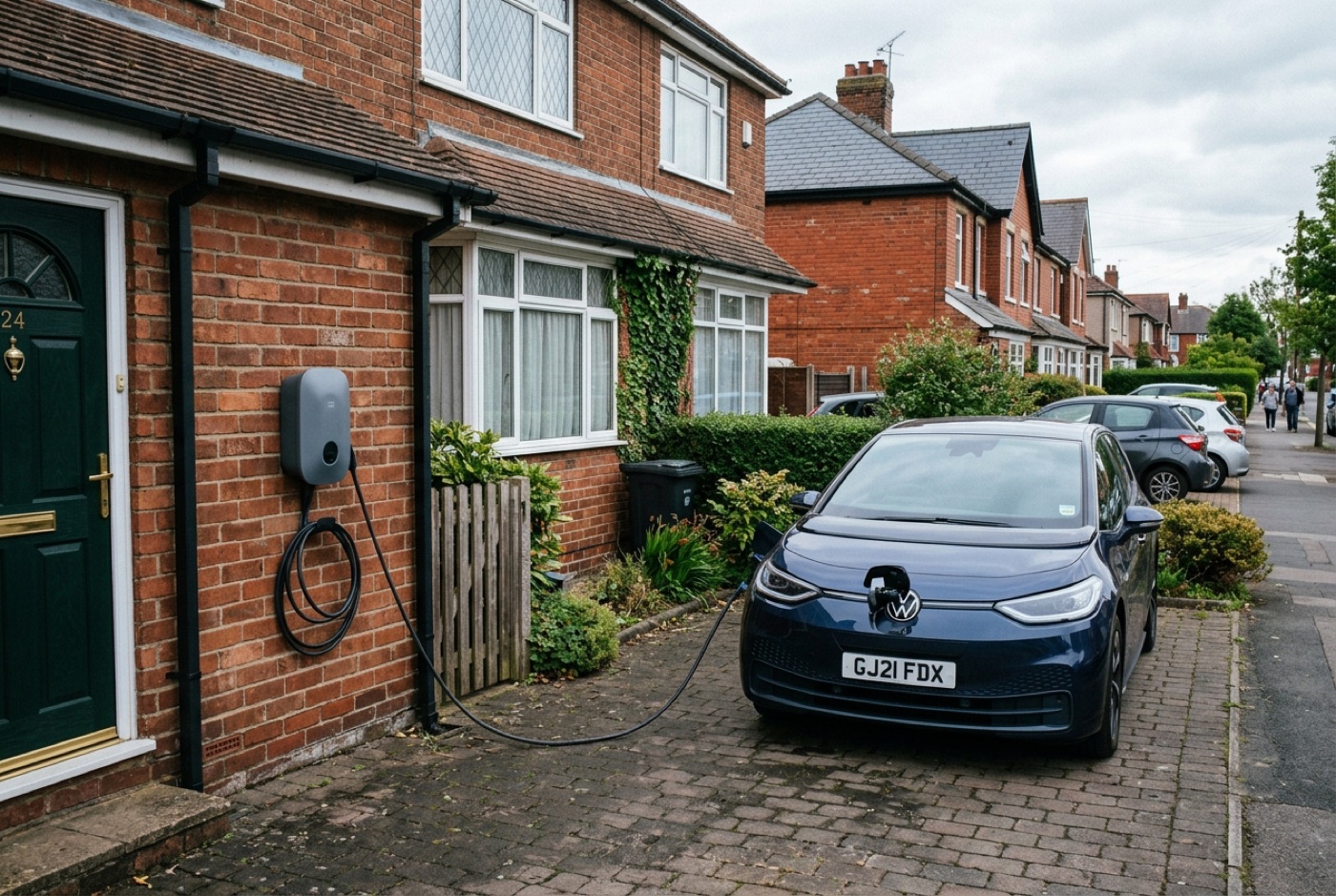
A standard 7kW home EV charger is fitted by an OZEV-approved installer and includes the unit, isolator, cabling and DNO notification. The EV chargepoint grant gives up to 350 pounds towards one for people in flats and rented homes. Costs vary with the cable run and any supply upgrade, so get a quote.
Ready to get this done? We match you to a small number of vetted local trades who hold the right accreditation, never a dozen cold-callers. Free for homeowners.
Get matchedOZEV grants that remain in 2026
The general homeowner EV charger grant closed in 2022. Two replacement routes remain for households and businesses:
- Flat owners and renters: up to 350 pounds towards an OZEV-approved charger via the EV chargepoint grant. Landlord consent is required for renters.
- Workplace Charging Scheme: support per socket for businesses, up to a capped number of sockets.
The load-management rule for older houses
A 7kW charger draws roughly 32A. On older 60A or 80A main fuses, common in Victorian terraces and many flats, adding that on top of an induction hob and an electric shower can overload the main supply. There are two ways round it.
Two ways to handle a tight supply
- Dynamic load management: a smart charger throttles its draw based on whole-house consumption, usually via a CT clamp the installer fits.
- Supply upgrade: ask your distribution network operator (DNO) for a service upgrade. It is often free or low-cost, but expect a lead time of several weeks.
What the price should include
- The unit, tethered or untethered, with the cable length you need.
- OZEV-approved installer labour.
- A surge protection device where the consumer unit lacks one.
- The correct RCBO type for your charger.
- A reasonable cable run from the consumer unit to the charger position.
- DNO notification, which is mandatory.
- The EIC and Building Control notification, plus app and tariff setup.
When the price goes up
- A long cable run beyond a standard allowance, charged per metre.
- A core-drilled run through a brick wall.
- External cable management such as trunking or conduit.
- A garage charger with a separate sub-meter.
- A three-phase install for a faster unit.
What it costs
- 7kW home charger, fitted
- Get a quote Includes the unit, OZEV-approved labour, isolator, a standard cable run and DNO notification.
- EV chargepoint grant
- Up to 350 pounds off For people in flats and rented homes, fitted by an approved installer (gov.uk / OZEV).
- Load management or supply upgrade
- Get a quote A CT-clamp load limiter, or a DNO supply upgrade, where the existing main fuse is tight.
We do not publish a single fixed price; it depends on the unit, the cable run and whether your supply needs managing or upgrading. Get an itemised quote from an OZEV-approved installer.
How to choose a vetted trade
- Use an OZEV-approved installer; approval is required to claim the chargepoint grant and signals a competent installer.
- Confirm the installer is also a registered electrician who will issue the EIC.
- Ask whether your main fuse can take a 7kW charger, and get the load-management or supply-upgrade option priced before you commit.
Frequently asked questions
Is there still a grant for a home EV charger?
The EV chargepoint grant gives up to 350 pounds towards a charger for people living in flats or rented accommodation, fitted by an approved installer. Homeowners in houses are generally not eligible, though separate landlord and on-street schemes exist. Check gov.uk for current rules.
Can my house take a 7kW charger?
Most can, but older homes with a 60A or 80A main fuse may need dynamic load management or a supply upgrade, because a 7kW charger draws around 32A on top of your existing load. An OZEV-approved installer checks your supply first and prices the right option.
Why must the installer be OZEV-approved?
OZEV approval is required to claim the chargepoint grant and signals the installer meets the scheme standards. Using an approved, registered electrician also ensures the work is certified and notified to your DNO, protecting your warranty and your home.
Sources
Editor, VettedHome
Adam leads VettedHome's editorial coverage of UK home services. He is the founder and managing director of Muswell Rose, the commercial strategy and modern systems business behind a portfolio of UK information sites, and he researches and writes the plain-English guides that help homeowners choose between installers and trades, drawing on the standards set by bodies such as MCS, TrustMark, the Energy Saving Trust and the Property Care Association. He is clear about what to check before any work starts.
Last reviewed: 11 June 2026