Trades guideElectrical service
House rewire: a local electrician and what the job involves
A house rewire replaces the fixed wiring, sockets, switches and consumer unit, and is needed when the existing wiring is old, unsafe or failing an EICR. A compliant rewire ends with an Electrical Installation Certificate and Part P notification. We read your enquiry and reply by email; we do not pass your enquiry to a trade.
Need this done? Tell us the job and your postcode and you can send us an enquiry and we will reply by email. Check the accreditation of any trade before work starts. Free for homeowners.
On this page
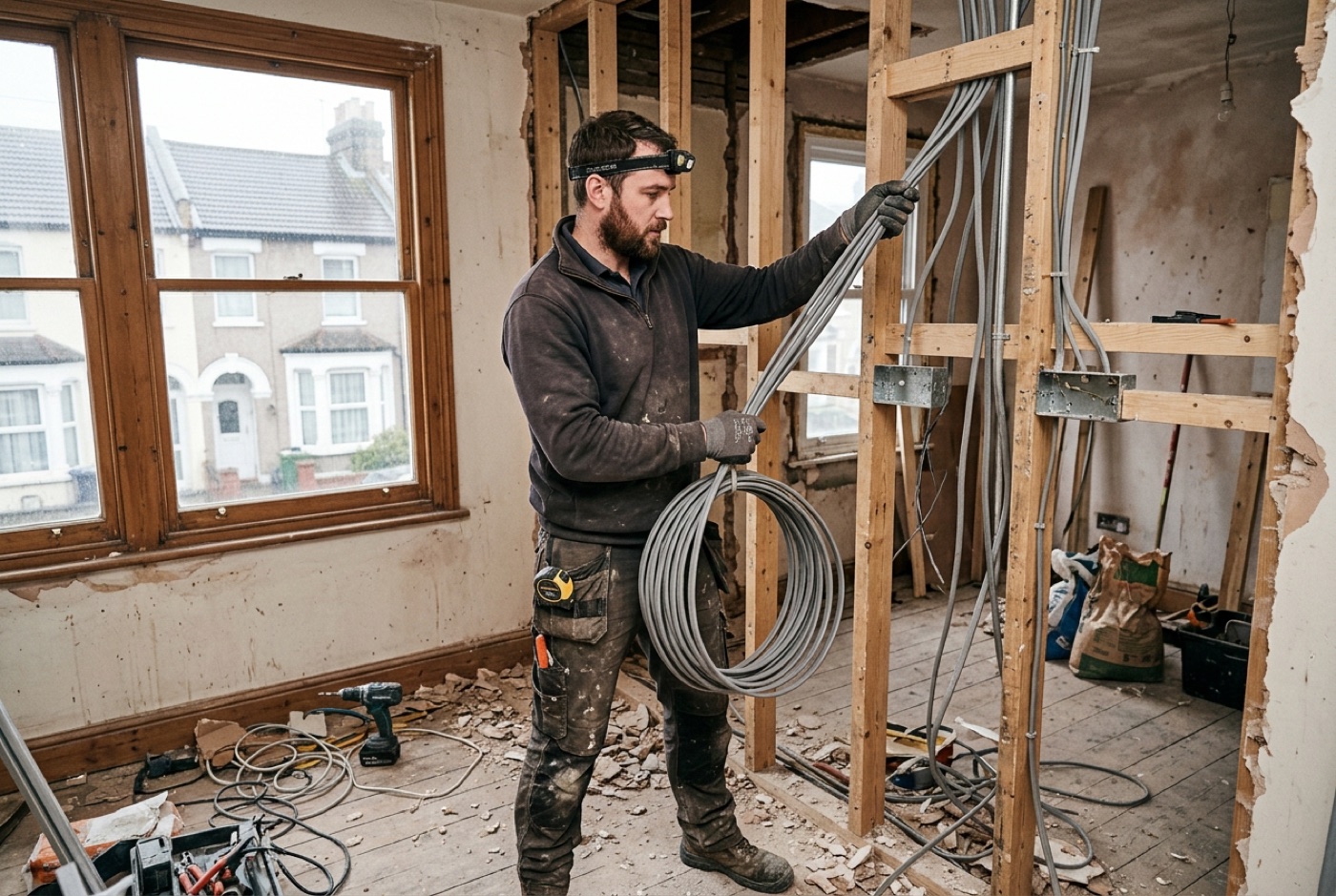
When a property needs rewiring
- Old rubber, lead or fabric-sheathed cabling, common in pre-1970s homes.
- A consumer unit and circuits that fail an EICR with C1 or C2 codes.
- Recurring faults, scorching or frequent tripping.
- A major renovation or extension that opens up the walls anyway.
Full vs partial rewire
A full rewire replaces everything. A partial rewire keeps any circuit that will pass an EICR with no C1 or C2 codes. If a C1 turns up mid-job, the electrician must disconnect that circuit, and a partial can become a full one. Budget for that possibility.
What the job must end with
An Electrical Installation Certificate, the consumer unit labelled and certified to the current wiring regulations, and Part P notification through the electrician scheme or Building Control. If your electrician cannot produce the EIC, the work is legally unfinished, so never pay the final balance without it.
What it costs
- Full or partial rewire
- Get a quote (all-in) Ask for one all-in figure including the consumer unit, certification and making good.
- What must be included
- EIC + Part P notification The certificate and notification are non-negotiable parts of the job.
For why the day-rate quote misleads and what pushes the price up, see the house rewire cost guide.
How to choose a trade
- Use an electrician registered with a competent-person scheme (NICEIC, NAPIT, ELECSA or Stroma).
- Get an all-in quote that names the consumer unit and lists making-good as a line, not an afterthought.
- Confirm the EIC will be issued at handover and get at least three itemised quotes.
Frequently asked questions
How do I know if my house needs rewiring?
Tell-tale signs are old rubber, lead or fabric-sheathed cabling, a consumer unit and circuits failing an EICR with C1 or C2 codes, recurring faults or scorching, or frequent tripping. A registered electrician can confirm with an inspection whether a full or partial rewire is needed.
Can I just rewire part of the house?
Sometimes. A partial rewire keeps any circuit that passes an EICR with no C1 or C2 codes. But if a C1 turns up mid-job, the electrician must disconnect that circuit on safety grounds, and a partial can become a full rewire. Budget for that possibility before starting.
What proves a rewire was done properly?
The Electrical Installation Certificate, plus Part P notification through the electrician competent-person scheme or Building Control. The consumer unit should be labelled and certified to the current wiring regulations. Without the EIC the work is legally unfinished, so do not pay the final balance until you have it.
Sources

Editor, VettedHome
Adam leads VettedHome's editorial coverage of UK home services. He is the founder and managing director of Muswell Rose, the commercial strategy and modern systems business behind a portfolio of UK information sites, and he researches and writes the plain-English guides that help homeowners choose between installers and trades, drawing on the standards set by the relevant bodies for each job, such as Gas Safe Register, NICEIC, MCS, TrustMark and the Property Care Association. He is clear about what to check before any work starts.
Last updated: