Home energyEnergy and green upgrades
Cavity and external wall insulation: cost and grants
Cavity wall insulation fills the gap between two layers of an external wall, while external wall insulation adds a layer to solid walls that have no cavity. Both cut heat loss. Eligible households may get help through ECO4, which runs to 31 December 2026. The Great British Insulation Scheme closed on 31 March 2026 and is no longer taking applications. Which suits you depends on your wall type.
We read your enquiry and reply by email. Check an installer's accreditation before work starts, using the guide below.
On this page
What it is
UK homes mostly have one of two wall types. Homes built from roughly the 1920s onwards often have a cavity (a gap between two layers of brick) that can be filled with insulation. Older or solid-wall homes have no cavity and instead need insulation added to the outside (external wall insulation) or inside.
Choosing the wrong method for your wall type causes problems, so the first step is identifying which walls you have.
How it works
Cavity wall insulation is injected through small holes drilled in the outer wall, which are then filled. It is quick, usually a day or less, and suits homes with a clean, dry, unfilled cavity.
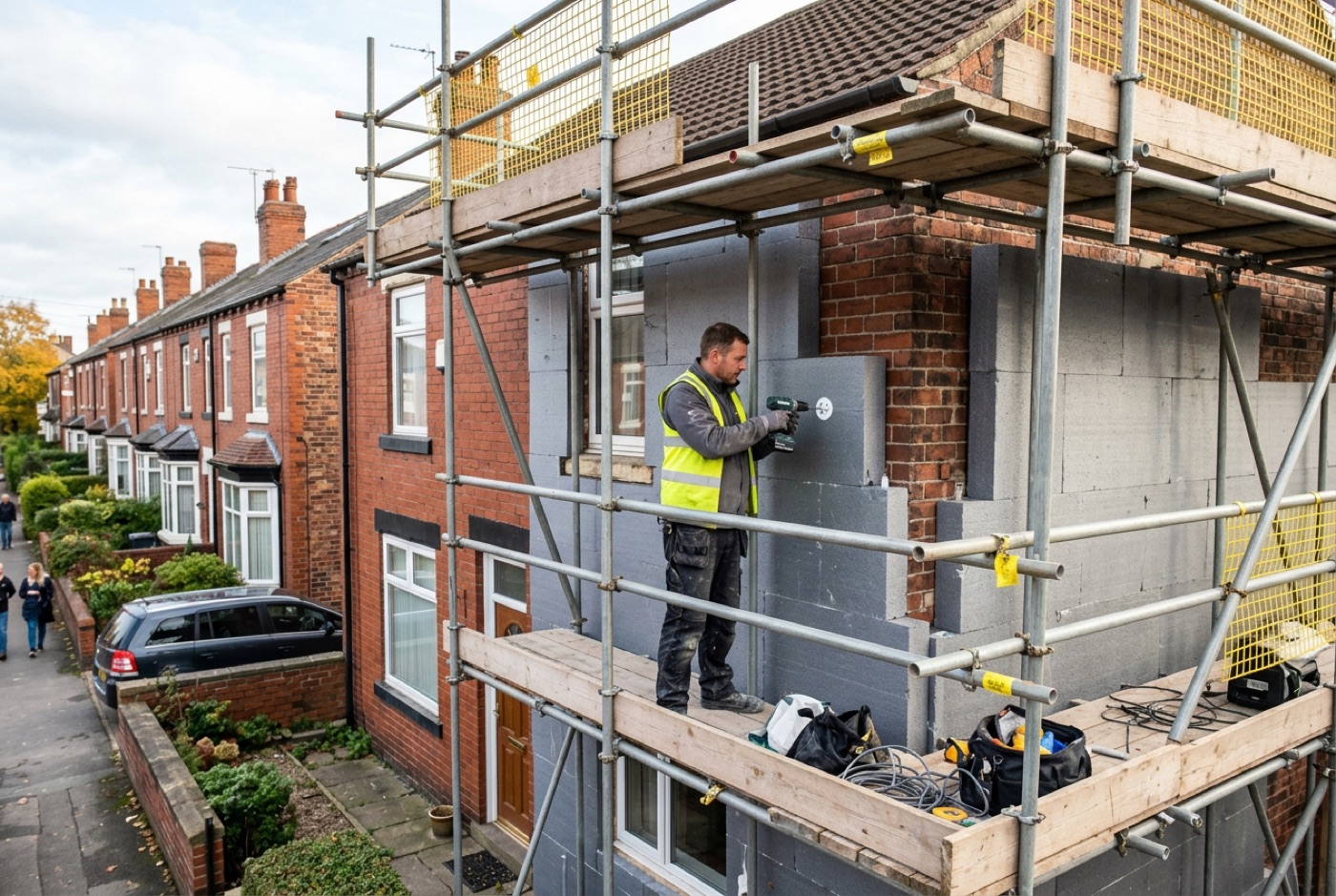
External wall insulation fixes insulation boards to the outside of a solid wall and finishes them with render or cladding. It is a bigger job that changes the look of the house and may need planning permission in some areas.
A survey first checks the wall is suitable and dry, because insulating a damp or unsuitable wall can trap moisture.
Cost
- Cavity wall insulation
- Get a quote Usually the cheaper of the two; suits homes with an unfilled cavity.
- External wall insulation
- Get a quote A larger job for solid-wall homes; cost depends on wall area and finish.
- If grant-funded
- ECO4 may help Means-tested support for eligible households, to 31 Dec 2026 (Ofgem).
Who it is for
- Cavity wall insulation: homes built with an unfilled cavity, typically from the 1920s onwards.
- External wall insulation: solid-wall homes, often pre-1920s, with no cavity to fill.
- Lower-income and benefit-eligible households, who may get either funded through ECO4 before it ends on 31 December 2026.
Grants and savings
- ECO4: means-tested funding for wall insulation in eligible homes, running to 31 December 2026 (Ofgem).
- Insulating walls reduces a major route of heat loss, lowering heating bills (Energy Saving Trust).
Cavity vs external wall insulation
| Factor | Cavity wall insulation | External wall insulation |
|---|---|---|
| Suits | Homes with an unfilled cavity (roughly 1920s on) | Solid-wall homes with no cavity |
| Disruption | Low, usually a day or less | Higher, a larger external job |
| Changes appearance | No | Yes, new render or cladding |
| Planning permission | Not usually | May be needed in some areas |
| Typical cost | Get a quote (lower) | Get a quote (higher) |
| Guarantee to look for | CIGA guarantee | System guarantee |
How to choose an installer
- For grant work the installer must be TrustMark-registered; for cavity work, look for a CIGA guarantee, and for external wall insulation, an appropriate system guarantee.
- Insist on a survey that confirms the wall is suitable and dry before any insulation goes in.
- Get the guarantee terms in writing and, for grant work, a clear statement of what is covered.
Frequently asked questions
How do I know if I have cavity or solid walls?
Homes built from roughly the 1920s onwards usually have a cavity; older homes are often solid wall. The brick pattern and wall thickness give clues, but a surveyor confirms it. The wall type decides whether cavity-fill or external wall insulation is right.
Can I get a grant for wall insulation?
Eligible lower-income or benefit-receiving households may get cavity or external wall insulation funded through ECO4, which runs to 31 December 2026, delivered by a TrustMark-registered installer. Eligibility is means-tested, so check the rules on gov.uk. The Great British Insulation Scheme closed 31 March 2026.
Is cavity wall insulation ever a bad idea?
It can be in homes exposed to driving rain or with damp problems, where filling the cavity could let moisture cross to the inner wall. That is why a survey must confirm the wall is suitable and dry first. A reputable installer will not insulate an unsuitable wall.
Sources

Editor, VettedHome
Adam leads VettedHome's editorial coverage of UK home services. He is the founder and managing director of Muswell Rose, the commercial strategy and modern systems business behind a portfolio of UK information sites, and he researches and writes the plain-English guides that help homeowners choose between installers and trades, drawing on the standards set by the relevant bodies for each job, such as Gas Safe Register, NICEIC, MCS, TrustMark and the Property Care Association. He is clear about what to check before any work starts.
Last updated: